
Devices left unattended
Laptops, drives and removable media can be left in open rooms, loading areas or unsecured crates while teams move between sites.
Relocating, consolidating or closing an office? IT Factory identifies retired equipment, destroys data-bearing devices and documents the final outcome.

Temporary storage, multiple suppliers and rushed handovers can weaken the controls normally applied to data-bearing equipment.
Laptops, drives and removable media can be left in open rooms, loading areas or unsecured crates while teams move between sites.
Multiple movers, contractors and internal teams can create gaps in the asset list, making it difficult to confirm where every data-bearing device ended up.
If collection and transfer points are not recorded, responsibility can become unclear while equipment is transported, stored or passed to another supplier.
Data-bearing equipment can be sent for reuse, resale or general e-waste processing before its data has been securely erased or physically destroyed.
Equipment is collected, but there is no complete record of which data-bearing assets were reused, destroyed or recycled.
The premises are cleared. Asset accountability remains open.Retired equipment is recorded, directed to an approved pathway and checked against the agreed asset list.
The organisation retains a clear final record.Both scenarios may result in an empty office. Only the second demonstrates controlled asset retirement.
We help organisations close the gap between technical project completion and lifecycle accountability.
Service details, capture requirements and the available evidence are confirmed during project scoping.
Agree on locations, equipment types, volumes, custody requirements and the approved retirement list.
Select on-site destruction where witnessing or custody requirements favour processing at the premises, or controlled off-site processing where collection is appropriate.
Capture the agreed identifiers and check completed processing against the original asset list.
Provide the agreed certificates, destruction records, reconciliation and exception reporting.
A properly scoped evidence package can connect the approved release decision to the final treatment outcome.
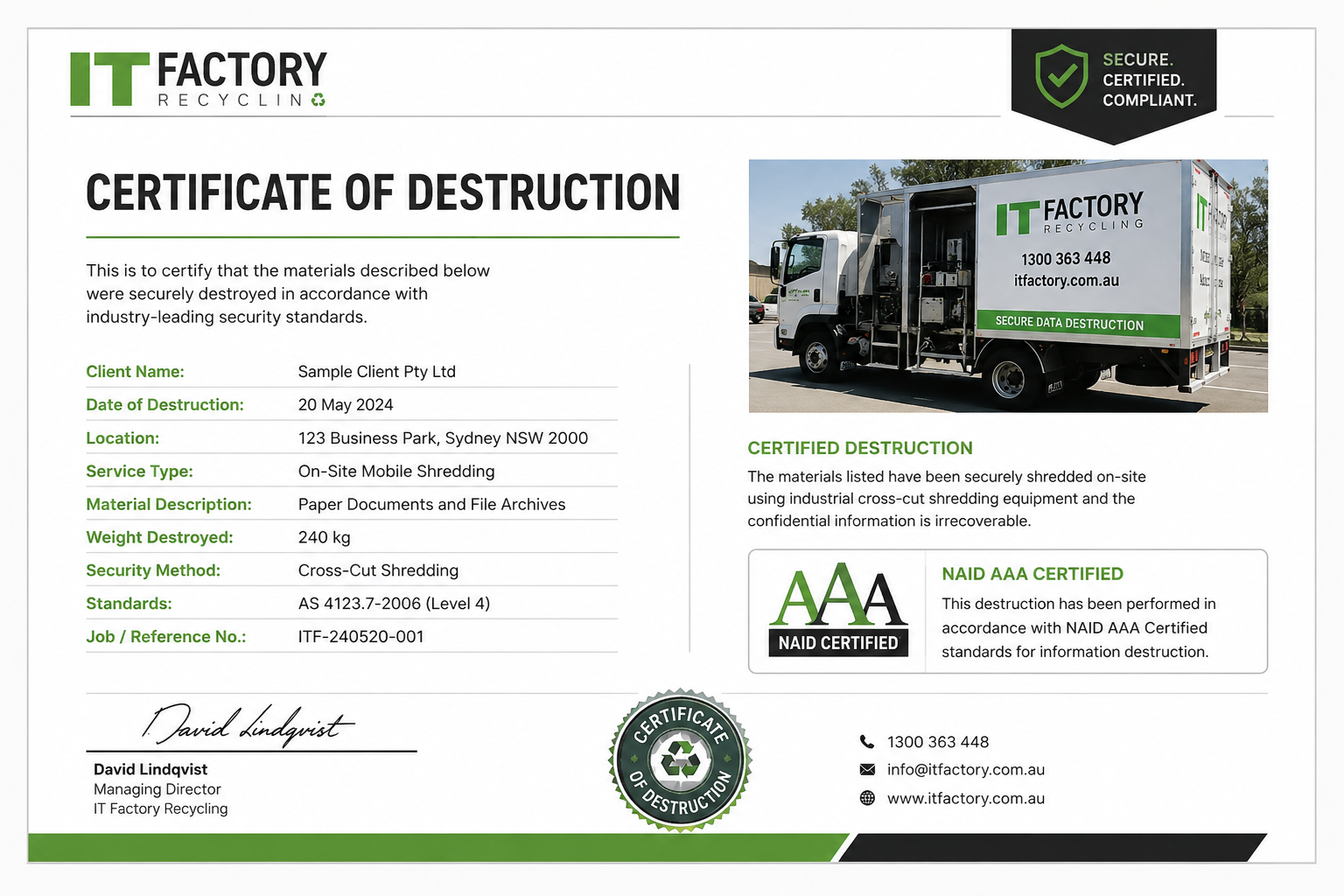
We confirm the most appropriate pathway during project scoping.
Best when destruction must be completed or witnessed at your workplace.
Best when secure collection and documented processing suit the project.
Provide the equipment type, estimated quantity, location and preferred service model. We will confirm the practical scope, required records and timing.